

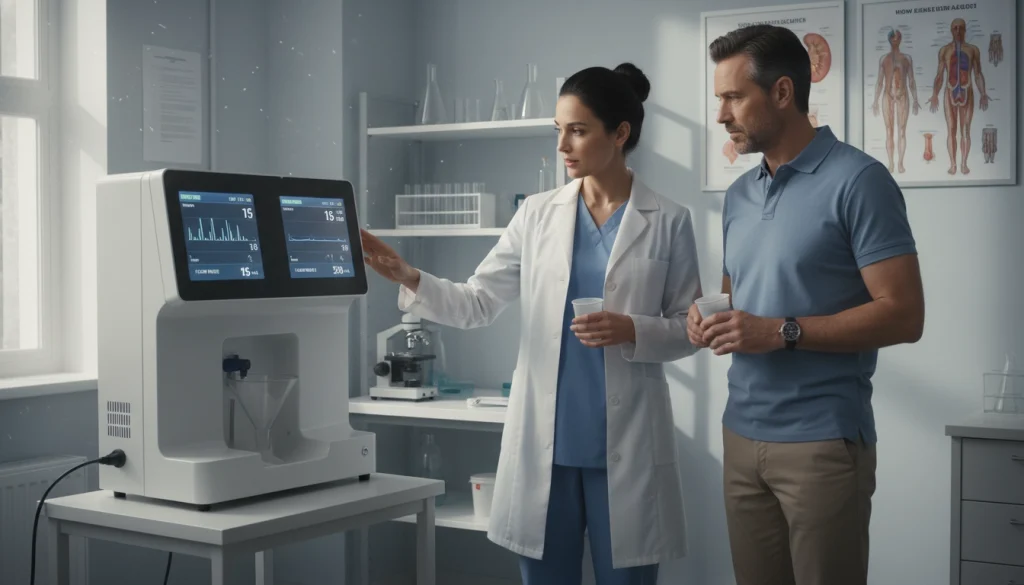
Treatment Snapshot
When you see a urologist, they might ask you to do a test to check your bladder health. A Urine Flow Test is a simple, non-invasive way to see how well your body empties urine.
Medical visits can be scary. But, this test is easy, painless, and very important. It helps find any problems with your urinary system. Our team uses this data to give you the best care for your needs.
We want you to feel sure and informed during your visit. We’re here to help you on your path to better health. We do this through clear talk and expert advice.
Key Takeaways
- This procedure is a non-invasive way to evaluate bladder and urethral function.
- It provides essential data on how well you can empty your bladder.
- The process is completely painless and serves as a standard diagnostic tool.
- Understanding this assessment helps you approach your appointment with confidence.
- Our team uses these results to create a personalized care plan for your wellbeing.
Understanding the Purpose of a Urine Flow Test
A urine flow test is a key test for checking how well your urinary system works. It measures how fast and much urine you make. This helps us understand your urological health.
This test is a first step for those noticing changes in their urine habits. It’s a non-invasive way to start looking into health issues.
Why Physicians Order Uroflowmetry
Doctors often suggest this test for symptoms like a weak stream or trouble starting to pee. The goal is to find out what’s causing the problem. Accurate data collection is key to making a treatment plan just for you.
This test helps us find problems that might not be obvious. It lets us track how well treatments are working. This way, we can catch issues early and avoid bigger problems later.
The Role of Flow Rate in Diagnosing Obstructions
The test focuses on the flow rate, or how much urine you make per second. A low flow rate can mean a blockage or weak bladder muscle. We look at the flow curve to find where the problem is in the urinary tract.
The table below shows how symptoms relate to what we look for in our tests:
| Symptom | Clinical Focus | Diagnostic Goal |
|---|---|---|
| Weak Urinary Stream | Flow Rate Analysis | Identify Obstruction |
| Hesitancy | Voiding Mechanics | Assess Muscle Function |
| Incomplete Emptying | Residual Volume | Detect Retention |
| Frequent Urination | Bladder Capacity | Evaluate Storage |
By looking at these patterns, we can figure out if your symptoms are from a blockage or a nerve issue. Knowing this helps us find the best way to help you get better and stay healthy.
Anatomy and Physiology of the Urinary Tract
To understand urinary issues, we need to know about the bladder and urethra. These organs work together to store and release fluid. Knowing how they work helps us appreciate our body’s daily functions.
How the Bladder and Urethra Function Together
The bladder is a muscular reservoir that holds urine until it’s time to go. Its walls stretch as it fills up. This stretchiness lets it hold different amounts of urine without too much pressure.
The urethra is the tube that connects the bladder to the outside. It has two muscle groups called sphincters. These muscles keep the urethra closed, stopping urine from leaking out until you’re ready to go.
- Detrusor muscle: Contracts to push urine out.
- Internal sphincter: Keeps the bladder neck closed.
- External sphincter: Provides voluntary control over the flow.
The Mechanics of Normal Micturition
Micturition, or urination, is a highly coordinated process. It involves the nervous and muscular systems. When the bladder is full, it sends signals to the brain. This tells the body it’s time to find a restroom.
When you decide to go, the brain sends a signal back to the bladder. The detrusor muscle contracts, and the sphincter muscles relax. This lets urine flow smoothly.
If this balance is off, you might have trouble starting to urinate or have a weak stream. Understanding these mechanics helps us spot when something’s not right. We believe knowing this can help you take care of your urological health.
Clinical Indications for Uroflowmetry
We use uroflowmetry to check how well your urinary system works every day. It measures urine flow speed and volume. This helps us see if your bladder and urethra are healthy.
This test is non-invasive. It finds blockages or issues that might not be seen by other tests.
Identifying Symptoms of Urinary Retention
Many patients tell us their bladder doesn’t empty fully after they pee. This is called urinary retention. Symptoms include a weak or interrupted stream, trouble starting to pee, or needing to strain.
Spotting these signs early is key to avoid serious problems later.
A flow test gives us data that physical exams can’t. It shows if there’s a blockage or a weak bladder muscle. By looking at flow rates, we get a clear picture of your situation.
Monitoring Progress During Treatment
We also use this test to see how well you’re doing with treatment. Whether you’re taking medicine or recovering from surgery, regular tests help us see if things are getting better. This way, we can keep your treatment plan on track.
Watching these changes is part of our promise to give you top-notch care. If your flow rate isn’t improving, we can change your treatment plan. Your health journey is a team effort, and we’re here to guide you with the facts.
Preparing for Your Urine Flow Test
Getting ready for your Urine Flow Test is key to a good check-up of your urinary health. By following a few easy steps, you help us get the best data for your health journey. This prep ensures your Urine Flow Test shows your bladder’s function accurately.
Hydration Guidelines Before the Appointment
When you come to the clinic, make sure your bladder is full but not too full. This is because the test checks how well your bladder empties naturally. If your bladder isn’t full enough, the test results might not be clear.
Drink a moderate amount of water about an hour before your visit. Don’t drink too much, as it can make your bladder too full. You want to feel a strong urge to go when you get here.
Medications to Discuss with Your Doctor
Talk to your doctor about your medications before the test. Some drugs, like those for blood pressure or prostate issues, can affect your bladder. These might change your flow rate, which could impact your Urine Flow Test results.
Bring a list of all your medicines, including supplements and herbal remedies, to your appointment. We’ll check if any need to be stopped or changed for the test. Talking openly about your health helps us give you the best care.
| Preparation Step | Action Required | Reasoning |
|---|---|---|
| Hydration | Drink water 60 minutes prior | Ensures a full bladder for accurate measurement |
| Medication Review | Bring a list of all current drugs | Identifies substances affecting bladder muscles |
| Comfort | Wear loose, easy-to-remove clothing | Promotes relaxation during the procedure |
| Communication | Discuss symptoms with the staff | Helps tailor the Urine Flow Test analysis |
The Step-by-Step Procedure of the Urine Flow Test
Knowing what to expect will make you feel more at ease. We want your visit to be as easy as possible. This test is simple, quick, and doesn’t hurt.
Arriving at the Urological Clinic
When you get to the clinic, our team will welcome you. They’ll help you with the first steps, like filling out a form about your symptoms or medications. Then, you’ll go to a private area to wait until it’s time for the test.
- Confirm your identity and verify your medical history.
- Receive instructions on how to use the specialized equipment.
- Wait in a quiet, private space until your bladder is comfortably full.
Using the Uroflowmeter Device
The Urine Flow Test uses a device called a uroflowmeter. It’s like a high-tech funnel that catches your urine. You can use it just like a regular toilet, and it records your urine flow without touching you.
Ensuring Privacy and Comfort During the Test
Your privacy and comfort are our top priorities during the Urine Flow Test. The room is private and safe, so you can relax. Our team is here to support you and answer any questions you have.
We want to make the test easy for you. Our goal is to help you while we get the information we need. If you have any questions, just let us know before we start.
Understanding Uroflowmetry Equipment and Technology
At the heart of every successful uroflowmetry test lies a sophisticated piece of medical equipment. We use these devices to capture the subtle details of your urinary flow with high precision. They convert physical output into digital data, giving us a clear view of your bladder function.
How Electronic Sensors Measure Volume
The uroflowmeter is designed to be both sensitive and reliable. Most modern units use electronic sensors to detect the weight or speed of the urine stream. These sensors track the volume of fluid passed over time with remarkable accuracy.
This process happens in real-time, ensuring that every milliliter is accounted for during your session. Because the equipment is highly sensitive, it can detect even minor changes in flow. This objective measurement is a cornerstone of our diagnostic approach.
The Role of Computerized Data Analysis
Once the sensors capture the raw data, the device transmits it to a computer system. Our software then processes these numbers to generate a visual flow curve. This graph shows the relationship between your flow rate and the duration of the voiding process.
Computerized data analysis allows our urologists to identify specific patterns. These patterns indicate how well your bladder and urethra are working together. By reviewing these detailed curves, we can make informed decisions about your care. This integration of technology ensures that our assessments remain consistent, objective, and highly reliable for every patient we serve.
Interpreting Your Results
We believe that clear communication about your health data helps you make better choices. After your test, our specialists look at specific metrics to see how your bladder works. This turns raw numbers into a clear picture of your urinary health.
Defining Normal Flow Rates
The key metric we check is the maximum flow rate, or Qmax. This shows the fastest urine flow during voiding. The normal range varies by age, gender, and urine volume.
A bigger urine volume means a stronger, faster flow. If you pass a small amount, your flow rate might seem lower. We match your peak flow with total volume for an accurate check.
What Low Flow Rates Indicate
Low flow rates often mean a problem. This could be a physical blockage, like an enlarged prostate or a narrow urethra. It’s not just about the flow rate; it’s about what’s causing it.
Low flow can also mean weak bladder muscle contractions. We look closely to find the cause. Knowing the cause helps us plan the best treatment.
Analyzing the Flow Curve Shape
The flow curve shape gives us more clues. A healthy bladder has a smooth, bell-shaped curve. This shows steady flow increase and then decrease as it empties.
Any deviation from this shape can point to issues. For example, an irregular curve might mean you’re using pressure to empty your bladder. Below is a table showing how different curve patterns help us spot problems.
| Curve Pattern | Typical Appearance | Potential Clinical Meaning |
|---|---|---|
| Bell-Shaped | Smooth, continuous arc | Normal, healthy voiding |
| Flat/Plateau | Low, sustained flow | Possible urethral obstruction |
| Intermittent | Multiple peaks and valleys | Bladder muscle weakness or straining |
| Prolonged | Extended duration | Incomplete emptying or blockage |
Common Urinary Conditions Detected by the Test
Many urinary conditions can be found with a simple urine flow test. This test measures how fast and much urine you produce. It helps us spot issues like blockages or problems with how your urinary tract works. Early detection is key, as it lets us start treatments that greatly improve your life.
Benign Prostatic Hyperplasia (BPH)
In men, BPH often causes a slow or interrupted urine stream. This is because the prostate gland grows and presses on the urethra. This makes it hard for urine to flow.
The test shows us how this pressure affects your urine flow. We can see how bad the blockage is and choose the best treatment. This helps us tell if it’s just aging or if you need medical help.
Urethral Strictures and Obstructions
A urethral stricture is when scar tissue narrows the tube that urine flows through. This makes it hard for the bladder to push urine out. People often notice a weak or spraying stream, which means they need to see a doctor.
Our tests help find these blockages by looking at the flow rate graph. If the flow is low or takes a long time, it usually means there’s a blockage. Finding these early stops more serious problems like infections or bladder damage.
Bladder Outlet Obstruction
Bladder outlet obstruction means the bladder can’t empty well. BPH and strictures are common causes, but other things can also block the flow. We check to make sure your bladder isn’t working too hard because of a blockage.
- Reduced peak flow rates during the test.
- Prolonged time required to empty the bladder.
- A flattened or irregular flow curve pattern.
By understanding these patterns, we can create a care plan just for you. Our goal is to make you comfortable and confident again. We do this by finding and treating the real cause of your symptoms with accurate tests.
Factors That Can Influence Test Accuracy
Knowing what affects your urine flow test is key to getting accurate results. We aim to make you feel at ease, as many things can change the outcome. By tackling these factors together, we aim to give you the best care possible.
The Impact of Bladder Volume
The amount of urine in your bladder is very important. If it’s not full enough, your flow rate might seem lower than it really is. We suggest coming in with a bladder that’s just right, so we get a true picture of how you normally urinate.
Psychological Factors and Performance Anxiety
Many people get nervous during tests. This can make it hard to relax and urinate naturally. If you’re feeling anxious, please let our staff know. We’re here to help you feel more comfortable.
Physical Positioning During the Test
How you sit during the test is also important. Sitting comfortably lets us measure your urine flow more accurately. Our equipment is set up to help you find the best position for the test.
| Variable | Potential Impact | Recommended Action |
|---|---|---|
| Bladder Volume | Low volume may skew data | Follow hydration instructions |
| Anxiety Levels | Inhibits natural voiding | Practice deep breathing |
| Body Posture | Restricts flow mechanics | Use provided clinic support |
Comparing Uroflowmetry to Other Urological Assessments
Uroflowmetry gives us a quick look at how fast you urinate. But it’s just one part of a bigger picture. We often use it with other tests to understand your bladder better. This way, we can see your health clearly and find the best treatment.
Uroflowmetry Versus Cystometry
Uroflowmetry checks how fast and much urine you release. On the other hand, cystometry looks at bladder pressure as it fills and empties.
Cystometry is used to see how the bladder muscle works. It’s more detailed than uroflowmetry. We pick the right test based on your symptoms.
When to Use Post-Void Residual (PVR) Scans
A PVR scan shows how much urine is left in your bladder after you’ve finished. It’s key to see if your bladder is emptying right.
We use a portable ultrasound for PVR scans right after you’ve urinated. It’s quick and painless. It helps us spot issues like blockages that flow tests might miss. This way, we can make your treatment plan more precise.
| Test Name | Primary Purpose | Invasiveness |
|---|---|---|
| Uroflowmetry | Measures flow rate and volume | Non-invasive |
| Cystometry | Assesses bladder pressure | Minimally invasive |
| PVR Scan | Checks for residual urine | Non-invasive |
Potential Risks and Limitations of the Procedure
We think knowing the good and bad of medical tests helps you make better health choices. This tool gives valuable info on your urine flow. But, it’s just one part of a bigger health picture. We aim to give you care that’s full, right, and fits your needs.
Non-Invasive Nature of the Test
This test is a big plus because it doesn’t hurt. You don’t need to worry about needles or discomfort. Just pee into a special device in a private area.
There’s no risk of infection or harm because it doesn’t touch your urinary tract. It’s great for people of all ages who are scared of more invasive tests. We care about your comfort and peace of mind.
Limitations in Diagnosing Complex Neurological Issues
This test is great for flow issues but not for all urinary problems. It’s not good for finding the cause of complex neurological issues. These need more detailed tests to see how nerves talk to muscles in the bladder.
The table below shows what this test can and can’t do:
| Feature | Capability | Limitation |
|---|---|---|
| Physical Comfort | High (Non-invasive) | None |
| Flow Dynamics | Excellent detection | Cannot identify nerve damage |
| Clinical Utility | Initial screening | Requires further testing for complex cases |
| Diagnostic Scope | Identifies obstructions | Cannot pinpoint neurological origins |
Remember, a normal test doesn’t mean you’re healthy. If you keep feeling bad, we’ll suggest more tests or visits to specialists. We’re here to find the answers you need for your health.
What Happens After the Test
Finishing the test is a big step toward better urinary health. After it’s done, we look at your data to find the best solution for you.
We follow a collaborative care model. This means you’re part of the team as we go over your results. You can ask questions and get answers in simple terms.
Discussing Findings with Your Urologist
Your urologist will study your flow rate data. This shows how your bladder and urethra work. In your next meeting, we’ll talk about:
- Looking at your flow curve’s shape and consistency.
- Comparing your results with what’s normal.
- Talking about any symptoms you had during the test.
- How these findings fit with your medical history.
Determining the Need for Further Diagnostic Imaging
At times, more tests are needed to make a clear diagnosis. If your first test doesn’t give enough answers, we might suggest more tests. This helps make sure your treatment is right for you.
More tests could include advanced imaging or special exams. We make sure any extra tests are really needed for your health. This step is key to creating a plan that’s just for you.
Pediatric Considerations for Urine Flow Testing
When we do a Urine Flow Test on a child, we’re very gentle. We want them to feel safe and willing to cooperate. We know that hospitals can be scary for kids, so we try to make it calm.
By focusing on comfort, we help kids relax during the test. This makes the whole process easier for them.
Adapting the Procedure for Children
We change the Urine Flow Test to fit kids better. We let parents stay with their kids for support. This helps a lot.
We also explain things in a way kids can understand. This makes the test less scary and more manageable.
We make sure kids have privacy too. We use a special bathroom area where they can go without feeling watched. This relaxed environment helps us get accurate results.
Common Pediatric Urinary Issues
There are many reasons a doctor might suggest a Urine Flow Test for a child. Finding these issues early helps a lot. Here are some common ones:
- Persistent bedwetting that extends beyond the expected age range.
- Frequent daytime accidents or an urgent need to use the restroom.
- Difficulty starting the flow of urine or a weak stream.
- Recurrent urinary tract infections that require further investigation.
- Pain or discomfort during the act of urination.
Our team cares deeply about every child. We work with families to make sure kids get the care they need. We always keep their feelings in mind.
Managing Anxiety Regarding Urological Testing
Feeling anxious about a urine flow test is normal. Our clinical team gets it and helps you feel better. It’s okay to feel uneasy about medical tests, but we’re here to help.
Tips for Staying Relaxed in a Clinical Setting
Getting ready mentally is as important as physically for a test. When you get to the clinic, try simple techniques to calm down. These can help you relax:
- Deep Breathing: Breathe in slowly through your nose for four seconds, hold for four, and breathe out through your mouth for six.
- Mindful Distraction: Bring a book, listen to calming music, or think of something positive to take your mind off things.
- Progressive Muscle Relaxation: Tense and then relax different muscle groups in your body to release stress.
- Arrive Early: Getting there early helps you relax before your test, avoiding the stress of rushing.
Communicating Concerns to Your Healthcare Provider
Talking openly with your healthcare team is key to a good experience. If you’re feeling nervous, tell our staff before the test. We’re here to listen and make you feel more at ease.
Ask any questions you have about the test. Knowing what’s happening can help reduce your anxiety. Together, we can make your visit as comfortable and professional as possible.
Advancements in Urinary Diagnostic Technology
We are in a new era for checking and diagnosing urinary health. The field of urology is growing fast, moving towards more precise and easy-to-use tools. These advancements mean our patients get the best care today.
Portable Uroflowmetry Solutions
Before, patients had to go to a doctor’s office for urine flow tests. Now, portable uroflowmetry solutions let patients test at home. These small devices help patients check their urine flow easily from home.
This change makes testing less stressful. It lets doctors see how urine flow works in real life. These tools are a big step towards better health monitoring.
Integrating AI in Urological Diagnostics
Artificial intelligence is changing how we look at medical data. By integrating AI in urological diagnostics, we can spot things that might be missed. These smart systems look at lots of data to understand bladder health better.
AI helps doctors make quicker, smarter choices about treatment. It makes results more accurate and helps predict problems early. We’re looking forward to how these tools will make health checks easier.
| Feature | Traditional Methods | Modern Technology |
|---|---|---|
| Testing Location | Clinical Office Only | Home or Clinic |
| Data Analysis | Manual Interpretation | AI-Driven Insights |
| Patient Comfort | Moderate | High |
| Diagnostic Speed | Delayed | Real-time |
Next Steps for Your Urinary Health Journey
Understanding your urinary health is a big step towards better wellness. You now know how to handle diagnostic tests confidently.
Make sure to review what you’ve learned. Bring any questions to your next visit with our urology team. Talking openly helps get accurate results and care that fits you.
We’ll work together to create a plan to tackle your symptoms. Our team focuses on your needs to help you live better.
At Acıbadem Healthcare Group, we’re here to support you. We offer expert advice and top-notch care. Your journey to better health begins with informed choices and working closely with your doctors.
FAQ
Q: What exactly is a Urine Flow Test and how does it work?
A: A Urine Flow Test, also known as uroflowmetry, is a key test at Acıbadem Healthcare Group. It checks how well your bladder and urethra work. You’ll urinate into a special device called a uroflowmeter.
This device measures urine volume, flow speed, and emptying time. It helps us understand your urinary health without any pain.
Q: Why would my physician at Acıbadem Healthcare Group order a uroflowmetry test?
A: We suggest this test for symptoms like a weak stream or trouble starting to urinate. It helps find issues like BPH or urethral strictures. This way, we can make a treatment plan just for you.
Q: How should I prepare for my appointment to ensure accurate results?
A: Getting ready for the Urine Flow Test is important. Come with a full bladder. Drinking more water before your visit helps.
Also, tell our team about any medicines you take. Some can affect how your bladder works and the test results.
Q: What does a “normal” flow rate look like on the test results?
A: A healthy flow rate looks like a smooth, bell-shaped curve. It depends on your age and gender. If the curve is flat or long, it might mean a blockage or weak muscles.
Our specialists will look at this to find out why you’re having symptoms.
Q: Is the Urine Flow Test the same as a Post-Void Residual (PVR) scan?
A: While related, they’re not the same. Uroflowmetry looks at urine flow. A PVR scan checks urine left in the bladder after urinating. We often use both to understand your bladder better.
Q: Can the test detect Benign Prostatic Hyperplasia (BPH) or other specific conditions?
A: Yes, uroflowmetry is great for spotting BPH, urethral strictures, and other blockages. By finding these early, we can treat them and improve your life.
Q: What happens if I feel anxious or can’t urinate during the test?
A: Feeling anxious is normal. We make sure you’re comfortable and private. If you’re struggling, we can help you relax and consider your feelings when looking at your results.
Q: Are there any risks associated with the Urine Flow Test?
A: The Urine Flow Test is safe and painless. It doesn’t use needles or catheters. We aim to make it stress-free while getting important information.
Q: How are the tests adapted for pediatric patients at Acıbadem Healthcare Group?
A: We treat kids gently and specially. Our pediatric team uses friendly language and a supportive setting. This helps us check common urinary problems in children.
Q: What advanced technology is used during the Urine Flow Test?
A: We use top-notch uroflowmeters with precise sensors and computer analysis. These tools, along with AI and portable tech, help us get accurate results. This keeps our diagnostics up-to-date.
Q: What are the next steps after my test is finished?
A: After the test, we’ll talk about the results with you. Your urologist at Acıbadem Healthcare Group will explain what the findings mean. They might suggest more tests or imaging to complete your care plan.