

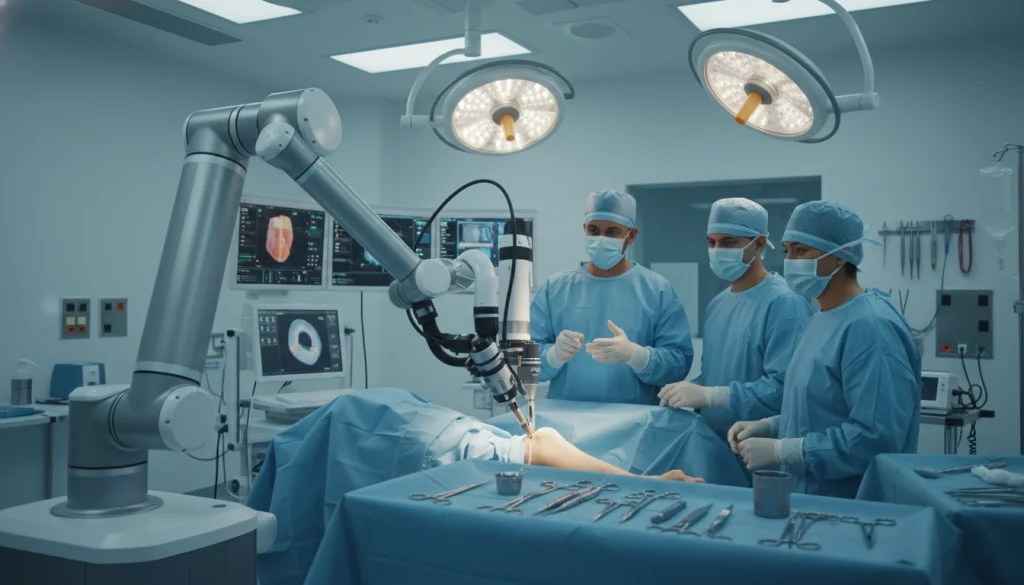
The Growing Demand for Robotic Knee Replacement SurgeryIn the United States, how doctors treat joint disease is changing. Patients want to move better and stay healthy longer. So, hospitals are using new tech to help. Hospitals are now all about new tech for better care.…
The Growing Demand for Robotic Knee Replacement Surgery
In the United States, how doctors treat joint disease is changing. Patients want to move better and stay healthy longer. So, hospitals are using new tech to help. Hospitals are now all about new tech for better care. Surgeons use digital tools to be more precise. This means patients get a total knee replacement that fits them perfectly. This focus on tech makes sure each patient gets care that’s just for them. We aim for top-notch surgery and safety for every patient. Our goal is to create a strong base for future medical care.
- Advanced surgical platforms are transforming the landscape of orthopedic care in the United States.
- Technological integration allows for higher precision and better alignment during complex joint procedures.
- Patient-centered outcomes are prioritized through the use of personalized, data-driven surgical planning.
- Modern institutions are committed to long-term sustainability and excellence in medical infrastructure.
- The shift toward high-tech interventions addresses the increasing demand for improved functional recovery.
The Evolution of Orthopedic Surgery and Knee Replacement
The field of orthopedic surgery has changed a lot. It used to rely on manual skills and guesswork. But now, it’s all about digital precision.
Computer-assisted navigation has changed knee surgery a lot. Surgeons can now see the body’s structures clearly. This has made joint replacements better and more precise.
New medical tech has helped a lot of people in the U.S. We focus on safe and proven practices. This helps joints last longer and work better.
We always check out new orthopedic surgery methods. We think combining human skill with robot accuracy is key. This way, we keep knees healthy and meet our patients’ high standards.
Understanding Robotic Knee Replacement Technology
Robotic technology in healthcare is changing how surgeons do joint reconstruction. It uses advanced software and mechanical precision. This makes it possible to achieve accuracy that was hard to get before.
At the core of these systems is real-time data analysis. During surgery, the robotic arm maps the patient’s body. This lets the surgeon make changes on the fly. It helps in getting the implants in the right place for better joint function.
Haptic feedback is another key part. It acts like a virtual boundary for the surgeon. If the tool gets too close to a sensitive area, it gives resistance. This robotic technology in healthcare helps avoid mistakes and keeps the surgery on track.
We are dedicated to the highest standards of care. Using Robotic Knee Replacement technology, we offer top-notch care. It focuses on patient safety and recovery. This technology is a big step forward in our goal to provide the best medical solutions.
The Rise of Robotic Knee Replacement in the United States
In the United States, medical centers are quickly adding robotic-assisted platforms. This change to Robotic Knee Replacement shows a big push for better patient care. Top hospitals are using these systems to meet the need for modern orthopedic care.
The main reasons for this change are the need for superior implant alignment and better surgical results. With advanced software, doctors can make each surgery fit the patient’s body perfectly. This is key for keeping joints healthy and making patients happy.
More patients want Robotic Knee Replacement because it means they can recover faster. Hospitals with this tech see quicker recovery times. This helps us work towards a better healthcare future for everyone.
Switching to robotic surgery also means better long-term clinical excellence. These systems make surgeries more consistent, leading to faster recovery. We’re committed to making a place where new ideas help both patients and doctors.
We’re keeping up with these changes while making sure safety and rules are followed. The move to Robotic Knee Replacement is changing orthopedic care for good. We’re excited to be at the forefront of this change, making healthcare better and more advanced.
Primary Benefits of Robotic-Assisted Knee Surgery
Modern joint replacement is all about precision, and robots are at the forefront. They use advanced imaging and real-time data for knee surgery. This means every movement is tailored to fit the patient’s unique body.
One big plus of robotic surgery is how it saves healthy soft tissue. Old methods needed big cuts, but robots do it with smaller ones. This meticulous approach helps keep ligaments and muscles safe, which is key for joint health.
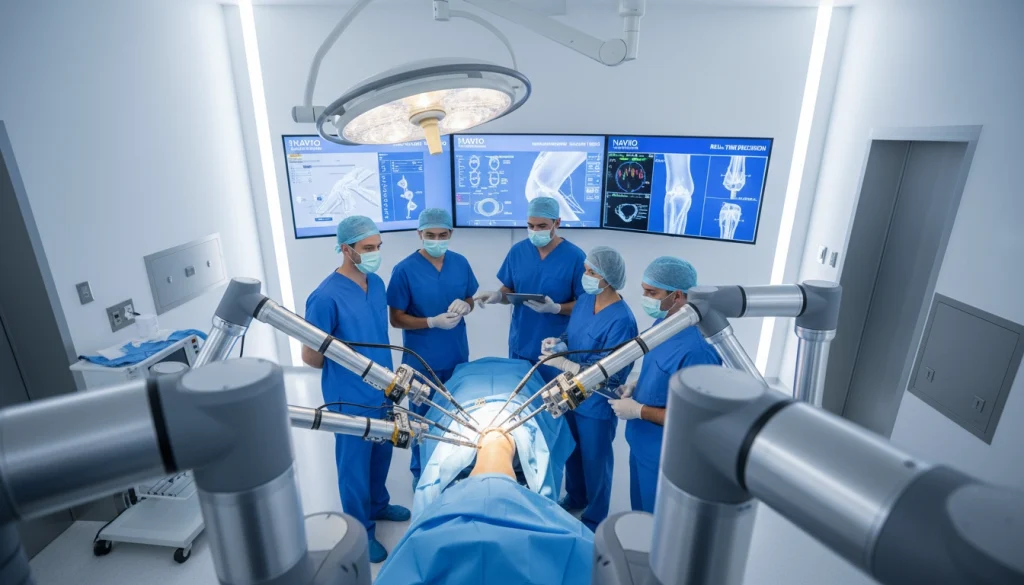
Custom implants are another big win. Surgeons can plan the surgery virtually, making sure the implant fits perfectly. This customization helps the prosthetic feel natural and last longer.
These robotic surgery benefits lead to better recovery times for patients. With such precise surgery, the body heals faster and with less pain. Patients can find out more about knee replacement surgery recovery details to see how it affects their daily life.
Our goal is to use these advanced tools in all knee surgery cases. We think combining skilled surgeons with robotic precision is the best way to make patients happy. This dedication to innovation means our patients get the top care in orthopedics today.
Leading Robotic Platforms in Modern Orthopedics
The world of orthopedic care is changing fast, thanks to a few top robotic systems. These systems are safe for patients and have been approved by the U.S. government. They use advanced software and precise mechanics to help surgeons do complex tasks with great accuracy.
These platforms are great because they mix preoperative imaging with live data during surgery. This mix makes sure each surgery fits the patient’s body perfectly. We’re all about keeping up with the latest tech to make our care top-notch.
The table below shows the main features of the top robotic systems in orthopedic surgery. Each one has special benefits that help make knee surgeries successful.
| Robotic Platform | Primary Technology | Key Clinical Benefit |
|---|---|---|
| Mako SmartRobotics | CT-based 3D Planning | High bone-preservation accuracy |
| ROSA Knee System | Real-time soft tissue balancing | Enhanced ligament tensioning |
| CORI Surgical System | Image-free mapping | Streamlined surgical workflow |
These systems are a big step up in surgical technology. Our teams can get better results and help patients recover faster. We keep checking these systems to make sure our care is the best it can be.
Patient Selection and Candidacy for Robotic Procedures
Finding the right knee replacement options begins with knowing your body and health history. Our team does a detailed check to see if robotic tech fits your needs. This way, we make sure you get a plan that fits your life. We use top-notch scans to see your knee’s exact shape. We also look at how active you are. This helps us predict how well you’ll do after surgery. It’s all about keeping our promise of quality and safety.
Not everyone needs the same treatment, which is why we have many knee replacement options. Our experts look at your bone health, ligament strength, and how worn your cartilage is. This careful check helps us give you the best results for the long run.
| Candidacy Factor | Traditional Surgery | Robotic-Assisted |
|---|---|---|
| Joint Anatomy | Standardized | Patient-Specific |
| Precision Level | Manual Alignment | Sub-millimeter |
| Recovery Time | Moderate | Accelerated |
| Ideal Candidate | General Cases | Complex/Active |
Our aim is to give you nurturing care that lets you live your life fully again. We think informed patients make the best choices for their health. By using new tech and caring for you, we lead the way in joint replacement care.
The Surgical Process: From Pre-Operative Planning to Recovery
To find lasting knee pain relief, we follow a detailed plan. We start with advanced 3D imaging to map the patient’s body. This helps surgeons plan the implant placement before surgery. During knee surgery, a robotic system helps the surgeon. It uses real-time data for precise bone cuts. This precision is key for healing and balance.
The table below shows the patient’s journey. It highlights our systematic approach for success.
| Phase | Primary Focus | Patient Benefit |
|---|---|---|
| Pre-Operative | 3D Mapping | Customized Surgical Plan |
| Intra-Operative | Robotic Precision | Improved Implant Alignment |
| Post-Operative | Structured Rehab | Restored Functional Mobility |
After surgery, we start a rehab program for knee pain relief. We focus on early movement to help patients quickly regain their independence. This smooth transition is key to our care. We use technology and care to ensure top knee surgery standards. Our aim is to improve mobility and quality of life. We support our patients every step of their recovery.
Comparing Clinical Outcomes and Long-Term Success
The main goal for surgeons and patients is to find lasting knee pain relief. Thanks to new technology, there are more knee replacement options now. These options focus on both being precise and lasting a long time.
Studies show that robotic-assisted surgery is better at aligning implants than traditional methods. This is key for making sure the implant works well in the patient’s body. Using robotic knee replacement helps surgeons be more accurate. This reduces the chance of the implant failing early. Patients often say they’re happier with robotic surgery. They can get back to their daily lives faster and feel more stable. These positive results show our dedication to using data to improve healthcare.
When looking at knee replacement options, it’s important to consider what makes a surgery successful. The table below shows how traditional and robotic-assisted surgeries differ in terms of results and recovery.
| Metric | Traditional Surgery | Robotic-Assisted |
|---|---|---|
| Implant Alignment | Standard Accuracy | High Precision |
| Soft Tissue Damage | Moderate | Minimal |
| Recovery Speed | Baseline | Accelerated |
| Long-term Stability | Reliable | Enhanced |
The right surgery depends on the patient’s health and the surgeon’s skills. We keep improving our methods to give every patient the best knee pain relief. Our goal is to provide lasting, high-quality care for everyone.
Addressing Common Misconceptions About Robotic Surgery
Many people think robots do the work in knee replacements. But, the truth is, the robot is just a smart tool for the surgeon. The surgeon is in charge from start to finish.
Some worry that technology might take over. But, the system gives the surgeon real-time data. This helps the surgeon make better choices. The tech uses advanced images to make sure everything fits the plan perfectly. These robotic surgery benefits bring a level of accuracy that’s hard to get by hand.
The robot doesn’t do the surgery alone. It’s a tool to help the surgeon. When we talk about robotic surgery benefits, we mean better precision and safety for the patient.
| Common Myth | Clinical Reality |
|---|---|
| The robot performs the surgery. | The surgeon controls every movement. |
| Robots replace human skill. | Technology enhances human expertise. |
| Robotic surgery is experimental. | It is a proven, standard-of-care tool. |
We focus on surgeon-led care with the latest tech. We want to make sure our patients know their safety is our top concern. Knowing about these robotic surgery benefits makes patients more confident in choosing advanced orthopedic care.
The Economic Impact of Robotic Technology in Healthcare
Investing in robotic technology in healthcare is a big decision. It balances high costs with long-term savings. Big hospitals must think about how these technologies affect their money. By choosing innovation, hospitals can stay ahead. They can also keep focusing on what matters most: the patients. The main economic gain is better surgical efficiency. With robots, surgeries are more precise and take less time. This means hospitals can see more patients without lowering care quality.
Also, fewer complications after surgery help save money. Shorter hospital stays and fewer readmissions cut costs. This is a big win for hospitals aiming to save money. We aim to match high-tech spending with smart budgeting. We see robotic technology in healthcare as a smart investment. It helps us offer top-notch care to all our patients.
| Metric | Traditional Surgery | Robotic-Assisted |
|---|---|---|
| Operating Time | Standard | Optimized |
| Recovery Duration | Baseline | Reduced |
| Complication Rate | Moderate | Minimized |
Training and Certification for Orthopedic Surgeons
The success of orthopedic surgery today depends on the ongoing education of our teams. Surgeons go through tough certification programs to learn about robotic-assisted surgery. This makes sure every surgery is done to the highest level of quality.
Our doctors keep up with new tech by constantly learning. This way, we offer the best care based on the latest research. Learning is key to keeping our patients safe. We think that knowing how to use new tech is as important as being a skilled surgeon in orthopedic surgery. We check and update our surgeons’ skills often. This keeps them at the top of their field. It also helps us stay focused on safety and doing things right.
Future Innovations in Robotic Knee Replacement
We’re seeing a big change in surgery with artificial intelligence and robotic precision. The next Robotic Knee Replacement will use deep learning to quickly analyze patient anatomy. This lets surgeons make detailed plans before they even start. The robotic technology in healthcare is getting better at using real-time data during surgery. Soon, machines will adjust to changes in soft tissue right away. This means every implant will be perfectly placed for the best results.
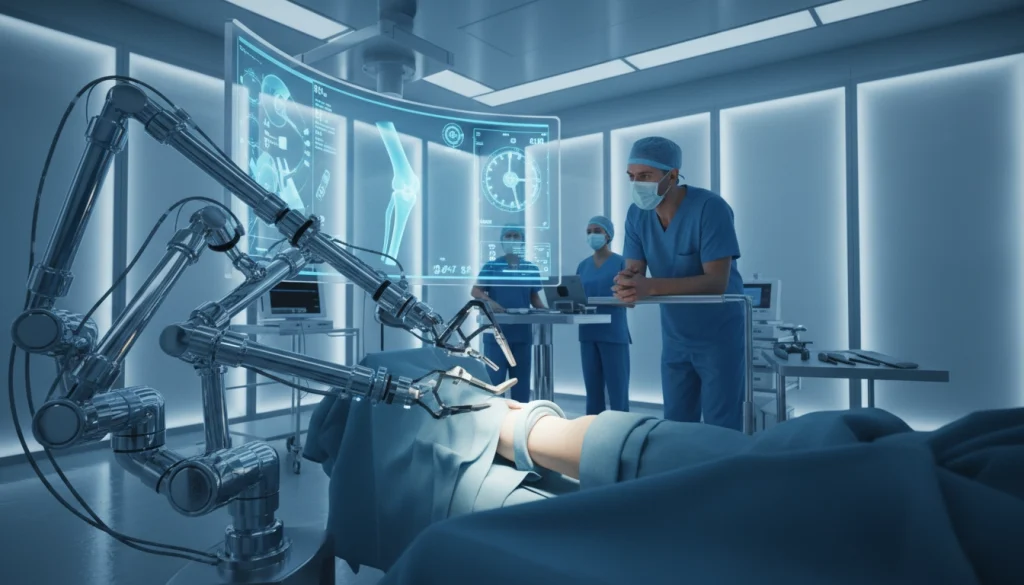
We’re leading the way in making orthopedic care better and more sustainable. We think enhanced surgical precision means patients recover faster and have better joints long-term. By using the latest technology, we give our patients the best care possible. Looking to the future, combining human skill with robotic technology in healthcare will keep changing what’s possible. We’re working hard to make the Robotic Knee Replacement even better. Our goal is to stay at the top of medical advancements for years to come!
The Future of Personalized Knee Health Solutions
Modern medicine is at a crossroads, blending digital precision with each patient’s unique needs. We’re committed to improving our surgical methods to meet each person’s recovery needs. Our goal is to find knee replacement options that boost long-term mobility and comfort.
We aim to merge robotic systems like Mako SmartRobotics and ROSA Knee System into everyday care. We think the best knee health comes from combining advanced tech with human care. By using patient-specific data, we craft surgeries that fit each person’s body perfectly. We’re also focused on creating a green healthcare future. Our team works to make surgeries more eco-friendly without sacrificing safety. We aim to set a global standard for care that benefits future generations!
FAQ
Q: What is the primary advantage of choosing a Robotic Knee Replacement over traditional manual procedures?
A: Robotic Knee Replacement offers unmatched precision and customization. It uses 3D digital mapping to fit the procedure to each patient’s unique anatomy. This leads to better implant alignment, more preserved soft tissues, and better long-term knee health.
Q: Does the robot perform the knee surgery independently?
A: No, the robot doesn’t do the surgery alone. A skilled surgeon is always in control. The robot, like the Stryker Mako SmartRobotics system, helps by giving real-time data and feedback. This helps the surgeon stay on track while keeping the human touch in surgery.
Q: What are the specific robotic surgery benefits regarding patient recovery?
A: Patients often recover faster thanks to the technology’s minimally invasive nature. The benefits include less damage to tissues and better ligament balancing. This means less pain, quicker mobility, and faster knee pain relief than traditional methods.
Q: How do I know if I am a candidate for these advanced knee replacement options?
A: Our specialists will check if you’re a good fit through a detailed evaluation. They look at your medical history and imaging to see how bad the joint disease is. Most people who need traditional surgery can also get robotic-assisted procedures for a more personalized approach.
Q: Which leading robotic platforms are utilized in your orthopedic departments?
A: We use top-notch, approved platforms for the best care. This includes the Stryker Mako, Zimmer Biomet ROSA Knee System, and Smith & Nephew CORI surgical system. These show our commitment to using the latest in healthcare technology.
Q: How does robotic technology in healthcare improve the longevity of a knee implant?
A: Robotic tech helps place implants perfectly, like the natural knee. This reduces wear and tear, making the implant last longer. It also means less pain and better knee health for the patient.
Q: What training do surgeons undergo to perform a robotic-assisted orthopedic surgery?
A: Our surgeons get special training and certification. They learn through simulation, clinical proctoring, and ongoing education. This keeps them up-to-date with the latest in orthopedic surgery.
Q: Is there an economic or environmental benefit to choosing robotic-assisted knee replacement options?
A: Yes, there are benefits. Robotic systems make care more efficient and cut down on complications. This saves resources and helps the environment. It also means we can focus on quality care for future generations.
Q: What future innovations can we expect in the field of Robotic Knee Replacement?
A: Future advancements will include artificial intelligence and machine learning. These will improve planning and decision-making during surgery. We aim to lead in healthcare innovation, giving patients the best options available.
Clinical Expertise & Trust Center
Healthcare decisions often involve more than a single treatment option. The experts, technologies and centers presented here reflect areas of expertise that are commonly associated with this topic, helping patients better understand available care pathways across the Acibadem Healthcare Group network.